

Where History Comes Alive: My Czech Experience
I had the opportunity to spend an Erasmus exchange semester at the Protestant Theological Faculty of Charles University in Prague. Looking back, it was far more than an academic stay. It was an opportunity to experience Czech culture from the inside. These are some of the moments that left the strongest impression on me.
Welcome
As a PhD candidate, my Erasmus experience differed from that of most undergraduate students. I was not required to collect credits, which gave me the freedom to focus on my research while exploring the country and its culture. I greatly appreciated the support of the International Office, especially Vera Fritzová, whose efficiency, kindness, and openness made every administrative step remarkably smooth. My academic supervisor, Doc. Tabita Landová, was equally supportive, while Klára Müllerová welcomed me upon arrival, showed me around the faculty, and provided a valuable introduction to student life. Erasmus students enjoyed the same privileges as Charles University students, including access to university facilities, city libraries, and the National Library. I also appreciated the flexibility to choose between university accommodation and arranging my own housing, the opportunity to attend conferences and seminars, and the option to learn Czech.
Cultural immersion
What I valued most, however, was not the academic side but the cultural immersion. Living among Czech people taught me far more than any book could. My interest in the Czech Republic began with its reputation as one of the world's most secular societies, a subject particularly fascinating from the perspective of practical theology. Reading authors such as Tomáš Halík and Pavel Hošek while living in their cultural context gave me a much deeper understanding of Czech Christianity, its history, and its relationship with secular society. Visiting a wide variety of churches, from Roman Catholic and mainline Protestant congregations to English-speaking evangelical communities such as Heart Prague Church, broadened my perspective even further. Although language was sometimes a barrier, local friends often helped with translation, making these experiences possible. They also inspired me to reflect more deeply on mission, pioneering ministry, and the fruitful cooperation already taking place between Czech and Dutch Christians.
The pub
The Buddy Program proved invaluable for newcomers looking for a local guide, while ESN events, sports activities, university life, and church communities made it easy to meet both Czech and international friends. Thanks to this network, I quickly discovered what became one of my favourite aspects of Czech culture: the pub. Unlike the stereotype of a place centred only on drinking, the Czech pub often serves as a social living room. I was pleasantly surprised to see people putting away their phones and spending hours discussing history, philosophy, politics, sports, or simply everyday life. I wish this habit would spread more widely, as genuine conversations around the table have become increasingly rare in a world dominated by screens.
Self-irony and dark humour
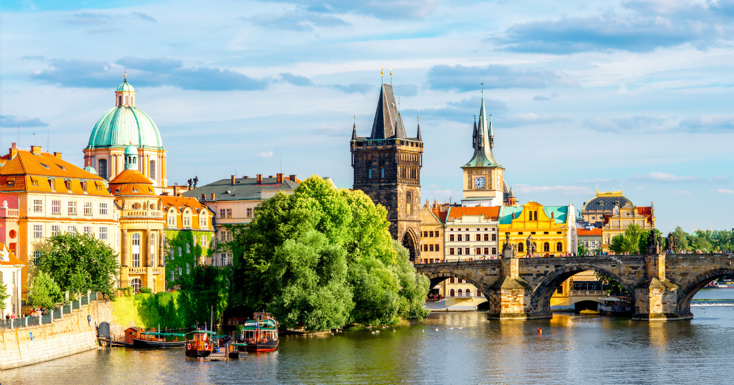
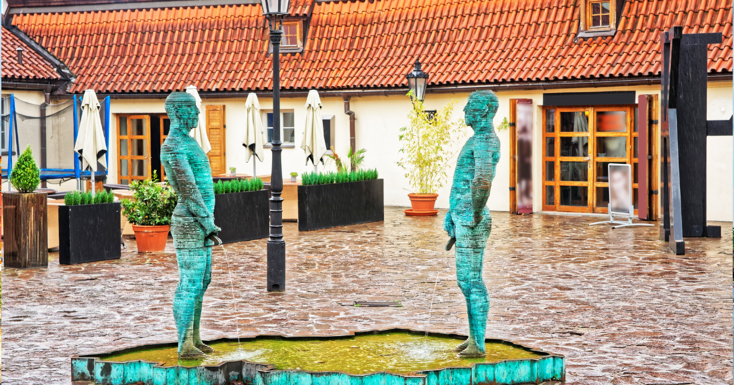
While the Astronomical Clock draws crowds from around the world, the Czech Republic is full of hidden gems waiting to be explored. Czechs take immense pride in their culture and history. They are capable of spending hours in passionate debates about battles fought centuries ago or fondly recalling the golden age of Czechoslovak industry in the 1920s and 1930s. Yet, despite this deep sense of national identity, they rarely take themselves too seriously. Self-irony and dark humour are deeply rooted in Czech culture. One famous example is David Černý's provocative sculpture Piss (2004), depicting two men urinating on the outline of the Czech Republic. It perfectly illustrates a nation that is willing to laugh at itself. Czechs can passionately argue over historical events from centuries ago, but they are just as capable of making fun of their own myths, symbols, and national pride. Perhaps that is one of the most then make a joke at your own expense.
Czech history
I have yet to encounter another culture that shows such enthusiasm and dedication to reenacting and reliving history. They seem almost obsessed with it. It’s fascinating to see how they recreate these moments during the Festival of the Five-Petalled Rose in Český Krumlov, transforming the entire historic centre into a medieval town, complete with knights, craftsmen, markets, music, theatre, and hundreds of participants in authentic costumes. Rather than simply preserving history in museums, Czechs actively relive it. The annual reenactment of the Battle of White Mountain offers another striking example. Participants recreate one of the defining moments of Czech history with remarkable historical accuracy, using period uniforms, muskets, cavalry, cannons, and military camps. Watching the event, I realised how deeply history remains woven into Czech identity not merely as something remembered, but as something continually experienced. I was equally impressed by the popularity of LARPing, where many people devote considerable time and creativity to fully inhabiting historical or fictional characters. Combined with the country's extraordinary architecture, countless castles and châteaux, and beautiful landscapes, travelling through the Czech Republic often feels like stepping into a fairy tale. Karlovy Vary became one of my favourite destinations, a magnificent city built around hot springs. No wonder it hosts the international film festival every year. Czech cuisine, especially its sausages, was another delightful surprise.
My Erasmus experience confirmed that education extends far beyond the classroom. Living in another country broadens perspectives, strengthens relationships, and creates a deeper appreciation of different cultures and ways of thinking. It also encourages us to reflect critically on our own society while learning from others. For all these reasons, I am deeply grateful for the Erasmus programme and the opportunities it provides.
Tollin
PhD Candidate
Protestant Theological University, Utrecht
